
Came across this passage called “Uji” meaning “being-time” or “for the time being” from Shōbōgenzō (Treasury of the True Dharma Eye) written by Dōgen in the year 1240. A simple analysis would be that “Buddha Nature is the inseparability of time and existence in the everchanging present.” It reminded me a lot of the realization or feeling of understanding I gained in my most recent ceremony - a feeling of connection and identification to and with all aspects and points of view, simultaneously. I thought maybe it would resonate with others here.
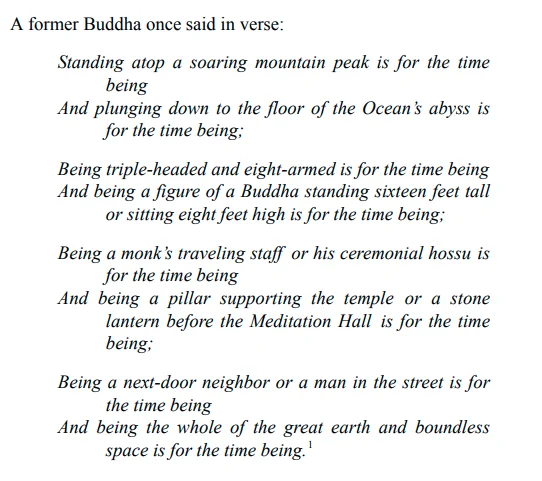

“In order to attain self-realization one must transcend the "ordinary" reality not by rising above it, and thereby separating oneself from it, but by "becoming" it, realizing oneself in it and the totality of the world, including "being-time" (from one Japanese philosopher’s interpretation of “Uji”)
I have found myself over the years desiring escape from samsara/physical incarnation/suffering and looking for that escape through detachment and spiritual bypassing - disassociating from this place/the material realm. Thinking I could float away into the ether somehow and be free. But I am slowly realizing the truth in teaching like this (despite my extreme resistance), that the “escape” is not in running away from life but embracing it, thereby transforming our relationship to the incarnate experience. Still got a long ass way to go but my resentment for having been born/existing in general is gradually subsiding. :)

@Libby England (She/Her) wow 🤯
so much truth in what you’ve said AND beautifully said. What a gift 🎁 💝

@Libby England (She/Her) sounds like not just one but 4 nobles truths! 😁

@Libbo this is a great insight that resonates very much with me!
Out of sheer coincidence, in the past 2 days I've been working on a section in an e-book that's exactly about this topic -- letting go of negative emotions by accepting them. Research led me to a widely used therapeutic model called Acceptance and Commitment Therapy. One core idea from ACT is a pattern called experiential avoidance, which refers to the tendency to dodge or suppress unpleasant internal experiences even when that avoidance causes long-term harm. Over time, the brain learns "avoidance feels safe," and begins to favor that option automatically.
I found an excerpt from my writing that's relevant to your experience:
"
But here’s the problem: research shows you can’t out-muscle fear. The more you fight it, the more power it gains. Instead, ACT teaches us to make space for negative emotions, which eventually decreases their hold over us.
This advice is backed by a growing body of research, including a well-known 2004 study conducted by psychologists Jill Levitt, Timothy Brown, Susan Orsillo, and David Barlow. The researchers wanted to test whether accepting anxiety, rather than fighting it, could reduce its impact.
They recruited participants who met criteria for panic disorder and randomly assigned them to one of three groups: a control group, a suppression group, and an acceptance group. Each participant was guided through a 10-minute audio session that explained one of the three strategies for dealing with anxiety:
The control group received no specific instructions on how to manage their anxiety.
The suppression group was instructed to actively push away or control their anxious thoughts and emotions.
The acceptance group was taught to simply observe their anxious thoughts without judgement or resistance.
Next, all participants were subjected to a carbon dioxide challenge, which involved breathing air enriched with 5.5% carbon dioxide: a method known to reliably induce symptoms of panic.
The results were striking. Participants in the acceptance group reported significantly less subjective anxiety and distress during the CO₂ challenge than those in the suppression or control groups. They were even more willing to take part in a second challenge afterward! By contrast, those who were told to suppress their anxiety were no better off than participants who received no strategy at all. This isn’t just one isolated finding – many subsequent studies and meta-analyses have reinforced the same conclusion. Acceptance of negative emotions consistently helps people manage them, but suppression tends to backfire.
A classic, intuitive ACT metaphor explains this well. Imagine you’re at a party, and anxiety shows up. You try to kick it out, but anxiety keeps knocking. The noise is distracting. You can't focus on anything else. Eventually, the party sucks – not because anxiety showed up, but because you spent the whole night trying to get rid of it. ACT teaches you to open the door, let anxiety in, and get back to enjoying the party. It's not ideal that it’s there, but at least the party’s still going.
"
If you're interested, ACT is definitely worth exploring! It's incredible to again see how so much Buddhist thinking is supported by research into similar concepts from psychology.
@Gleb Gariaev (He/Him) this is fascinating! Thank you so much for sharing, Gleb! I will definitely do some research on ACT. And that’s so cool you are writing a book, too. It seems to align with what we say often at church and in ceremony also, which is to “trust, allow, and surrender” - no matter what comes up or however terrifying it feels. Resistance inevitably generates more suffering.
Very insightful, thank you for sharing.